
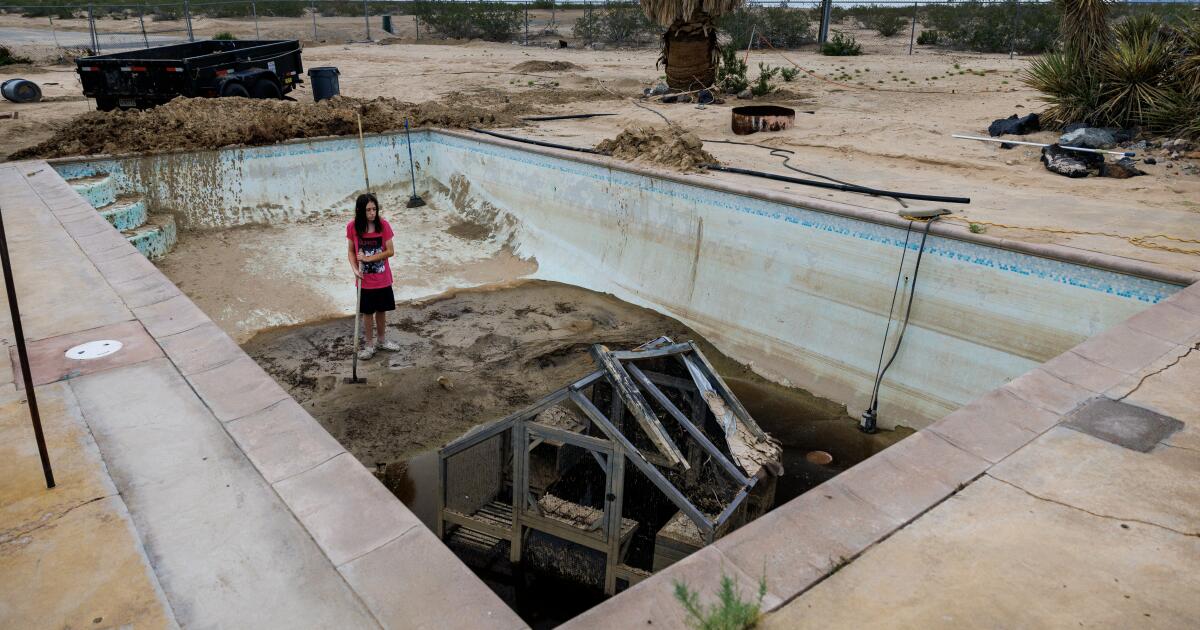

In the middle of summer, most Southern Californians would be surprised to see more than a handful of clouds in the sky (unless you count clouds of wildfire smoke). But on July 14 in Twentynine Palms, a rapidly developed thunderstorm dropped about 1.88 inches of rain in a couple hours — an overwhelming amount by historical standards for a town that typically gets less than 4 inches in an entire year.
The water rushed along streets and highways, picking up cars and driving debris to damage homes and businesses. Then, while residents were still taking stock of the destruction, nine days later the area was under a flash flood warning again as another thunderstorm moved through.
So why does the Mojave Desert — obviously an extremely arid place — receive all this summer rain while Los Angeles, less than 150 miles away, gets none?
Aggressive and impactful reporting on climate change, the environment, health and science.
Late summer is the driest time of year for much of California; on average, Los Angeles International Airport receives no rain at all during the month of August. But if you go east over the mountains into San Bernardino County, the pattern suddenly switches — in Twentynine Palms, August is the wettest month. Keep going into Arizona and New Mexico and the late summer precipitation gets even more intense: In Santa Fe, almost half of the year’s rain falls between July and September.
This changeover is the result of a phenomenon called the North American monsoon, which was responsible for the deluge in Twentynine Palms. While it is less well-known than its South Asian counterpart, the North American monsoon plays an important role in the climate of the Four Corners states, bringing crucial moisture to areas that would otherwise be bone dry, but also at times leading to damaging flooding.
All monsoons are driven by the same source: a difference in temperature between land and ocean. During the hot months of late summer, the sun can deliver as much as 1,000 watts per square meter in the subtropics — in terms of power, that’s similar to running a space heater every four feet. Some of this power is reflected into space, but on average more than two-thirds of it is absorbed, either by the land surface or by the ocean.
The essential difference between the two is that the ocean is constantly mixing, which distributes the heat throughout approximately the top 60 feet of ocean water — something that is impossible on land. As a result, the top few inches of soil or rock heat up rapidly over the course of a day, and in turn warm the overlying air.

Monsoon flood waters buckled and damaged the roadway at Kelbaker Road and Mojave Road inside the Mojave National Preserve in August 2022.
(NPS)
Since hot air is less dense than cold air, the air over the land tends to rise, typically in the late afternoon after a full day of baking in the sun. As the air rises from the land, it pulls in moist air from the water — for the North American monsoon, this is the Gulf of California — to replace it. When this moist air reaches mountainous terrain like that of northern Mexico and the American Southwest, it is pushed up and drops its moisture, often in sudden, intense thunderstorms.
There are many places near the coast that don’t have monsoons — Los Angeles, for instance. One important factor is topography: Research suggests that a major reason why the South Asian monsoon is so powerful and consistent is the presence of the Himalayas, which act as a wall that prevents air from the dry Tibetan plateau from making it to the Indian subcontinent.
Another major consideration is something called the “subtropical ridge,” which is a series of persistent high-pressure systems that all occur around 30 degrees north (and south) of the equator.
The reason that the North American monsoon does not reach coastal California is the presence of the North Pacific High, which is a part of the subtropical ridge that typically sits northeast of Hawaii. The North Pacific High strengthens and expands during the summer, creating the hot, dry conditions that are typical for Los Angeles and crowding out the monsoon. In winter, however, the North Pacific High tends to weaken and shift south, allowing atmospheric rivers to reach the state.
For the Southwest, the North American monsoon can be both a blessing and a curse.
It brings much-needed rain to the region, but that precipitation typically falls in torrential downpours that the dry, hard-packed soil is unable to absorb. This leads to dangerous flash floods that can destroy roads and buildings and potentially claim the lives of those caught in their path. The rain and cool conditions delivered by the monsoon can be useful in extinguishing wildfires, but the lightning from the storms is also a major trigger for wildfires in the region.
As with many weather phenomena, climate change is expected to have some effect on monsoon rainfall, but the magnitude and direction of that effect depends on specific local factors.
For some parts of the globe, like South and East Asia, monsoons are predicted to become more intense because of climate change. It is thought that changes in aerosol pollution as China and India (hopefully) shift away from coal power will play a very important role.
In the southern hemisphere, models suggest a possible small increase in summer monsoon rainfall. Of the major monsoon systems, only the North American monsoon is expected to have substantial decreases in total precipitation, with the most likely outcome being a 1%-6% reduction in summer rainfall. The reasons for this predicted decrease are not entirely understood but warming sea surface temperatures off the coast of Baja California have been suggested as a possible explanation.
If the North American monsoon does weaken over the coming decades, it will put further stress on the dwindling Colorado River, which has a watershed that includes almost all of Arizona and large swathes of Colorado and Utah. Perhaps more significantly, it will represent a serious threat to ecosystems that are already fragile because of rising temperatures and outbreaks of the mountain pine beetle.
The future of monsoon systems across the globe is not certain or easily predictable but given the potential perils in either direction — more intense flooding or deepening drought — it is important that we prepare for both scenarios and act quickly to limit these changes including by rapidly cutting emissions.
Ned Kleiner is a scientist and catastrophe modeler at Verisk. He has a doctorate in atmospheric science from Harvard.