
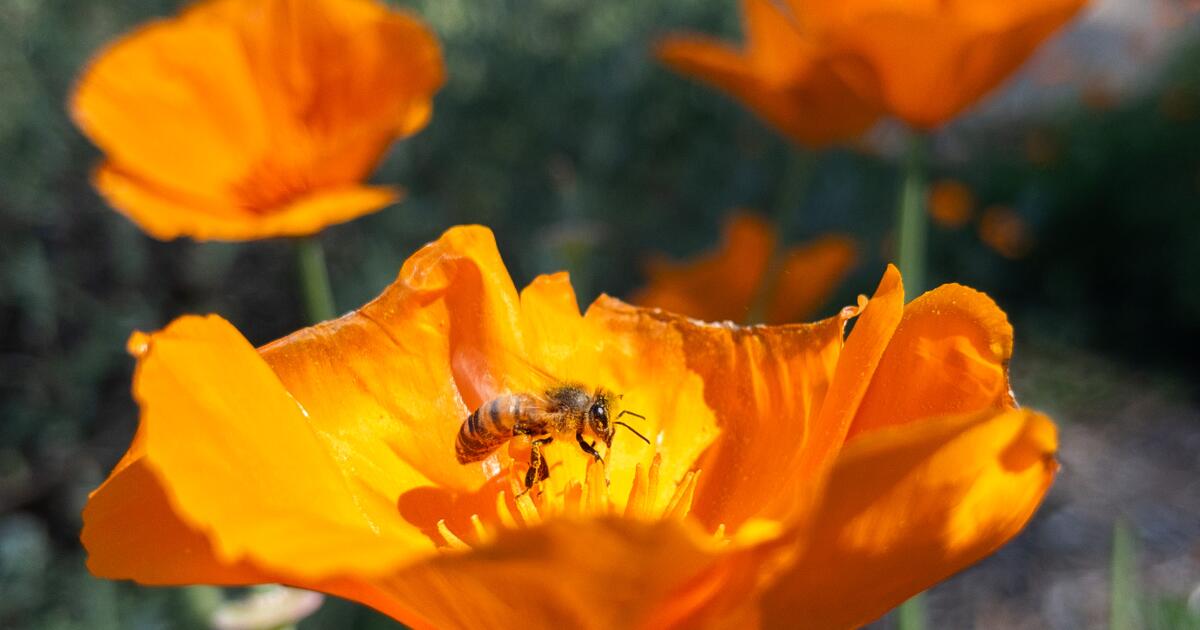

LOS ANGELES — You’ve probably heard the phrase: “Save the bees.” But new research suggests we may need to be more specific about which bees we’re saving.
Europeans introduced western honeybees (Apis mellifera L.) to the Americas in the early 1600s. They play an essential role in pollinating crops and flowering plants, and are often hailed as the “unsung heroes of our planet.” They are both omnivorous and omnipresent: Researchers have found that western honeybees visit more plant species than any other species of pollinator and are the most common visitor to plants in non-managed habitats worldwide, accounting for nearly 13% of all floral visitors.
The problem is that this dominance may be coming at the cost of some native pollinators.
That’s what caught the attention of Joshua Kohn, a former biology professor at UC San Diego. “Pollination biologists in general in North America tend to ignore western honeybees because they’re not native,” he said. “But when I saw just how abundant they were, I thought to myself: They’re not just a nuisance, they’re the story.”
In San Diego County — a global bee biodiversity hotspot — feral honeybee populations have quietly exploded in number since the late 1960s. Many of these bees trace their ancestry to a hybrid of European and African subspecies, the latter known for traits that boost survival in hot, dry climates — places with mild winters and vegetation that blooms year-round. In other words, perfect for Southern California, where previously domesticated populations became feral colonies that thrived independent of human management, nesting in rock crevices, abandoned rodent burrows and other natural cavities.
However, despite their population growth and spread, researchers don’t know much about these bees’ pollen consumption, or the extent to which their foraging habits may be displacing native species.
A new study published July 7 in the journal Insect Conservation and Diversity seeks to address that knowledge gap. Drawing from field surveys in San Diego’s coastal scrubland, researchers at UC San Diego found that feral honeybees — non-native, unmanaged descendants of domesticated bees — may be monopolizing local ecosystems and effectively squeezing out native pollinators such as bumblebees. In total, these feral bees now comprise about 90% of all bees in the area, according to the study.
“It’s like going to the Amazon rainforest to bird-watch and seeing only pigeons,” said James Hung, an ecologist at the University of Oklahoma and co-author of the study. “I was shocked. This was supposed to be a biodiversity hotspot — but all we were seeing were honeybees.”
The team also wanted to understand how honeybee foraging affected pollen availability for native species, and what that might mean for the latter’s ability to reproduce successfully. The researchers looked at how honeybees interacted with three native plants: black sage, white sage and distant phacelia. They found that in just two visits, a western honeybee could remove more than 60% of the pollen from these flowers. By the end of a single day for all three plant species analyzed, more than 80% of all pollen was gone.
The problem is that this leaves almost no pollen for native bees.
Kohn, a co-author of the study, explained that while western honeybees are prolific foragers, they aren’t always the most effective pollinators. His previous research suggests plants pollinated by these bees often produce less fit offspring, in part due to inbreeding. This is because western honeybees tend to visit many flowers on the same plant before moving on — a behavior that increases the risk of self-fertilization.
What this means for the broader plant community is still unclear, Kohn said. “But it’s likely that the offspring of plants would be more fit if they were pollinated by native pollinators. It’s possible that if honeybees were not in the system that there’d be more bumblebees, which visit flowering plants much more methodically.”
Kohn emphasized that the findings aren’t an argument against honeybee conservation, especially given their importance to agriculture. However, they do suggest we may need to reconsider how to manage domesticated western honeybee populations.
When used for agricultural pollination, managed honeybees are often brought into an area temporarily in what’s called a mobile apiary: essentially, dozens or hundreds of hives kept on a trailer or platform, moved from place to place, wherever pollination is needed. While this is essential for crops, stripping nectaring plants of resources before native species have a chance to feed could lead to their decimation.
Hung suggested designating specific forage zones for commercial beekeeping — ideally in areas less vulnerable to ecological disruption — as a way to offset that pressure. “If we can identify ecosystems that are less sensitive to disturbance — those with a lower number of endemic plant or pollinator species — we could scatter seed mixes and produce way more flowers than any comparable habitat nearby,” he said. “Then, we could set aside some acres of land for beekeepers to come and park their bees and let them forage in a way that does not disrupt the native ecosystem. This would address the conflict between large-scale managed honeybee populations and the wild bees that they could potentially be impacting.”
Rather than replacing crop pollination, the idea would be to offer alternative foraging options that keep honeybees from spilling into and dominating natural areas.
Longer-term, Hung said scientists may need to consider more direct forms of intervention, such as relocation or eradication. “Honeybees have dug their roots very deep into our ecosystem, so removing them is going to be a big challenge,” he said. But at some point, he believes, it may be necessary to protect native plants and pollinators.
In the words of Scott Black, director of the Xerces Society for Invertebrate Conservation, “Keeping honeybees to ‘save the bees’ is like raising chickens to save birds.”