

by Terry Heick
The long-term output of any school should be not just proficient students, but enabled learners. An “enabled” learner can grasp macro views, uncover micro details, ask questions, plan for new knowledge and transfer thinking across divergent circumstances. This doesn’t happen by content “knowledge holding,” or even by the fire of enthusiasm, but by setting a tone for learning that suggests possibility, and by creating a culture of can.
First, it’s important to realize that a “culture” is comprised of tangible factors (students) and intangible factors (curiosity). It is also ever-present — it exists whether or not we as educators acknowledge it. It precedes formal learning and will last long after that formal learning experience has passed.
Learning “I Can”
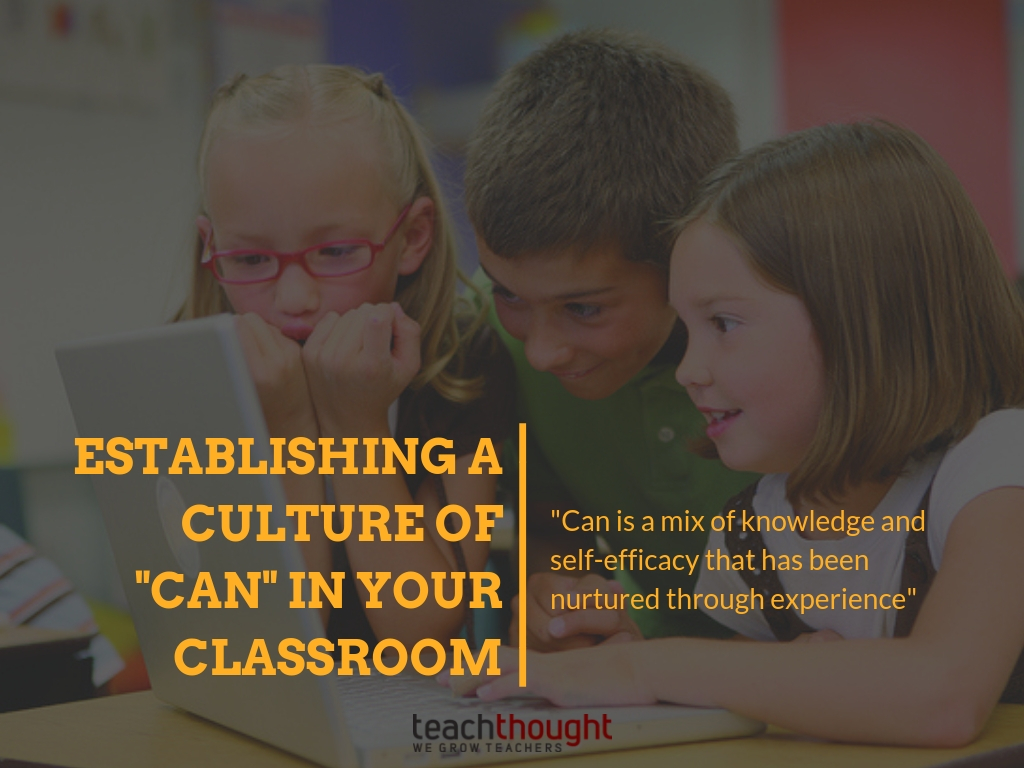
If a learner is to develop a sense of can, he or she must learn it. While some students have more natural confidence or initiative than others, can is slightly different than confidence. Can is a mix of knowledge and self-efficacy that has been nurtured through experience — by consistently meeting both internally and externally created goals judged by standards that are also both internally and externally drawn.
So how does this happen? Where does it come from?
In Developing Minds, a kind of anthology of ways to teach thinking edited by Art Costa, there are suggestions for promoting cognition and metacognition, including “creating a safe environment,” “following students’ thinking,” and “teaching questions rather than answers.”1
These suggestions often have emotional roots, implying that learning must be emotional (an implication that is hard to get away from). One broad approach to teaching that works nearly every single time — and can work here as well in creating a culture of can — is the gradual release of responsibility model.
Three Ways to Create “Can”
1. Use the Gradual Release of Responsibility ModelThe gradual release of responsibility model can be neatly summarized as “show me, help me, let me.” This funnels learner participation from a teacher-supported role of observation to a collaborative role with a “more knowledgeable other,” and finally to a role of independence that is hopefully sustained.
By definition, this pattern begins each time with the teacher in control, and ends with the expectation that the learner will assume control. It doesn’t throw learners into the deep end to manage the application of skills and concepts they are not ready for, but rather places the burden on the teacher to expertly model ideas and practice — and further, to view the end result of the learning process as an in-control, independent doer.
2. Intentionally Use the Individual Student as a Culture-Maker
Students gather individually to create a larger culture. Habits modeled in class, the tone of critical discussions, the mood of collaborative assignments and the relative ambition of projects and academic work all contribute to the culture of a classroom. If this culture comes from the top down, it ends up being more talk and “expectation” than actual culture. Culture is organic and nearly impossible to impose — but it can be nurtured and grown.
Honoring the contribution of learners is a critical factor. This is different than acknowledging their achievement, which can be either academic or patronizing. Contributions, however, involve nuance — supporting roles, emotional support, mini-milestones in long-term projects, and other “minor” actions.
In fact, there is more nuance here than any teacher with 35 students could ever possibly find the time to highlight. But as you make a practice of pointing out, highlighting and otherwise drawing attention to these actions and cognitive behavior, you’ll eventually see the other students doing the same.
And when that happens, you’re creating culture!
3. Diverse — and Authentic — Terms for Success
Nobody wants a well-intentioned ribbon for participation, but coming up with authentic terms for success in learning can make or break an experience for a child.
The more diverse the reading and writing, the more choice built into the project, the more self-designed the rubrics, the more “self-published” the multimedia, the more authentic the success. We’ve (hopefully) moved beyond strict “academics” where the teacher dictates the goals, domain and “end game” terms, and moved to a place that’s truly learner-centered, a place where students won’t make superficial decisions that barely alter the course of learning, but rather establish their own reasons to learn, their own standards for quality and their own metrics for success.
This is the foundation for a culture of can.
1Page 12-13, Developing Minds: A Resource Book for Teaching Thinking. “Thinking in Context: Teaching for Open-Mindedness and Critical Understanding.”
2A reference to Lev Vygotsky‘s relative term that identifies the “knowledge holder” in a learning process.
Image attribution flickr user luciellaribiero; Establishing A Culture Of “Can” In Your Classroom; this article was written by Terry Heick and originally published on edutopia.org
Founder & Director of TeachThought