

by Terry Heick
How can you tell if a student really understands something?
They learn early on to play the game—tell the teacher and/or the test what they ‘want to know,’ and even the best assessment leaves something on the table. (In truth, a big portion of the time students simply don’t know what they don’t know.)
The idea of understanding is, of course, at the heart of all learning, and solving it as a puzzle is one of the three pillars of formal learning environments and education.
1. What do they need to understand (standards)?
2. What (and how) do they currently understand (assessment)?
3. How can they best come to understand what they currently do not (planning learning experiences and instruction)?
But how do we know if they know it? And what is ‘it’?
Understanding As ‘It’
On the surface, there is trouble with the word ‘it.’ Sounds vague. Troublesome. Uncertain. But everyone somehow knows what it is.
‘It’ is essentially what is to be learned, and it can be a scary thing to both teachers and students. ‘It’ is everything, described with intimidating terms like objective, target, proficiency, test, exam, grade, fail, and succeed.
And in terms of content, ‘it’ could be almost anything: a fact, a discovery, a habit, skill, or general concept, from mathematical theory to a scientific process, the importance of a historical figure to an author’s purpose in a text.
So if a student gets it, beyond pure academic performance what might they be able to do? There are many existing taxonomies and characteristics, from Bloom’s to Understanding by Design’s 6 Facets of Understanding.
The following actions are set up as a linear taxonomy, from most basic to the most complex. The best part about it is its simplicity: Most of these actions can be performed simply in the classroom in minutes, and don’t require complex planning or an extended exam period.
By using a quick diagram, concept map, t-chart, conversation, picture, or short response in a journal, quick face-to-face collaboration, on an exit slip, or via digital/social media, understanding can be evaluated in minutes, helping to replace testing and consternation with a climate of assessment. It can be even be displayed on a class website or hung in the classroom to help guide self-directed learning, with students checking themselves for understanding.
How This Understanding Taxonomy Works
I’ll write more about this soon and put this into a more graphic form soon; both of these are critical in using it. (Update: I’m also creating a course for teachers to help the, use it.) For now, I’ll say that it can be used to guide planning, assessment, curriculum design, and self-directed learning. Or to develop critical thinking questions for any content area.
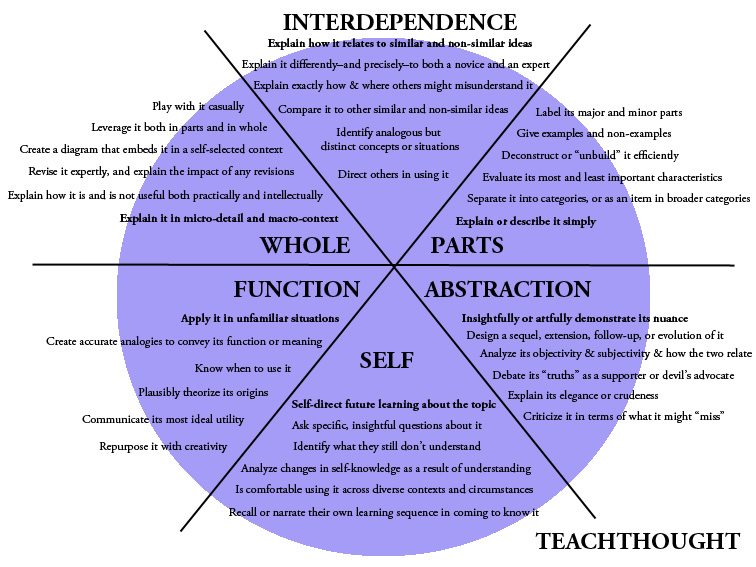
The ‘Heick’ learning taxonomy is meant to be simple, arranged as (mostly) isolated tasks that range in complexity from less to more. That said, students needn’t demonstrate the ‘highest’ levels of understanding–that misses the point. Any ability to complete these tasks is a demonstration of understanding. The greater number of tasks the student can complete the better, but all ‘boxes checked’ are evidence that the student ‘gets it.’
36 Thinking Strategies To Help Students Wrestle With Complexity
The Heick Learning Taxonomy
Domain 1: The Parts
- Explain or describe it simply
- Label its major and minor parts
- Evaluate its most and least important characteristics
- Deconstruct or ‘unbuild’ it efficiently
- Give examples and non-examples
- Separate it into categories, or as an item in broader categories
Example Topic
The Revolutionary War
Sample Prompts
Explain the Revolutionary War in simple terms (e.g., an inevitable rebellion that created a new nation).
Identify the major and minor ‘parts’ of the Revolutionary War (e.g., economics and propaganda, soldiers and tariffs).
Evaluate the Revolutionary War and identify its least and most important characteristics (e.g., caused and effects vs city names and minor skirmishes)
Domain 2: The Whole
- Explain it in micro-detail and macro-context
- Create a diagram that embeds it in a self-selected context
- Explain how it is and is not useful both practically and intellectually
- Play with it casually
- Leverage it both in parts and in whole
- Revise it expertly, and explain the impact of any revisions
Domain 3: The Interdependence
- Explain how it relates to similar and non-similar ideas
- Direct others in using it
- Explain it differently–and precisely–to both a novice and an expert
- Explain exactly how and where others might misunderstand it
- Compare it to other similar and non-similar ideas
- Identify analogous but distinct ideas, concepts, or situations
Domain 4: The Function
- Apply it in unfamiliar situations
- Create accurate analogies to convey its function or meaning
- Analyze the sweet spot of its utility
- Repurpose it with creativity
- Know when to use it
- Plausibly theorize its origins
Domain 5: The Abstraction
- Insightfully or artfully demonstrate its nuance
- Criticize it in terms of what it might ‘miss’ or where it’s ‘dishonest’ or incomplete
- Debate its ‘truths’ as a supporter or devil’s advocate
- Explain its elegance or crudeness
- Analyze its objectivity and subjectivity, and how the two relate
- Design a sequel, extension, follow-up, or evolution of it
Domain 6: The Self
- Self-direct future learning about the topic
- Ask specific, insightful questions about it
- Recall or narrate their own learning sequence or chronology (metacognition) in coming to know it
- Is comfortable using it across diverse contexts and circumstances
- Identify what they still don’t understand about it
- Analyze changes in self-knowledge as a result of understanding
Advanced Understanding
Understanding by Design’s 6 facets of Understanding, Bloom’s Taxonomy, and Marzano’s New Taxonomy were also referenced in the creation of this taxonomy; a learning taxonomy for understanding
Founder & Director of TeachThought