

by Terry Heick
Agreeing on how to best establish what a learner understands isn’t simple — if for no other reason then understanding itself isn’t simple.
The difference between gamification and game-based learning is important: the former uses encouragement mechanics to promote engagement, while the latter uses video games as core sources of learning material or cognitive action) is one response.
By embedding diverse achievements into activities and assessments, learning progress can be refracted infinitely. These systems would be able to more flexibly respond to unique learner pathways and abilities, and would further serve as encouragement mechanics — instead of one carrot stick, there are hundreds. And not just carrots, but every fruit and vegetable imaginable.
But video games have even more to offer formal learning systems. Lots more. While what actually constitutes a video game is changing with emerging technologies, in these digital playgrounds progress is usually iterative and requires players to demonstrate proficiency in certain areas.
To be able to do this before moving on to that.
See also 50 Ways To Empower Students In A Connected World
How Games Have Mastered Cognitive Engagement
There are tropes in video game mechanics that players almost universally dislike, including ‘training’ sessions, where players must prove to the video game that they can perform a basic function before moving on. Turn left, turn right, jump, pick up an object, open a map, etc.
Unskippable cut scenes that aren’t meaningful or integral to the game itself are also not fun.
A lack of player choice–games where developers lead you down a single path and offer the appearance of choice without offering any agency of note? Not ‘engaging.’
A game that’s too difficult or too easy? Not at all engaging.
A game where the mechanics themselves aren’t engaging–the actions and behaviors that players can actually control–isn’t fun because what you’re doing isn’t engaging. You’re just operating the functions of a pre-determined system that doesn’t need you, wasn’t created for you, doesn’t require specific genius or talent you might have, and looks and sounds and plays the same for every single player regardless of their abilities, background, goals, interests, etc. Sound familiar?
While something like a basic proving ground doesn’t sound bad in theory, it stifles fun because it destroys the players’ own sense of pace, interest, and curiosity. It is a stern reminder that you are playing a game, that the game is in control and you’re only along for the ride, which dissolves immersion as well.
Not much different than school, then.
Most game designers have learned, however. Mandatory training sessions and even unskippable cut scenes — breaks in play that force players to watch videos that may or may not be integral to the game — are less frequent than they were two years ago. They’ve also evolved unlocking. By performing tasks — as minor as opening a treasure chest, or as significant as completing a level — new “things” are unlocked: new areas, new weapons, new characters, new abilities, and so on.
These mechanics serve to encourage the player because to move forward, items need to be checked off — in a manner that is not only visible, but that rewards play, experimentation, and curiosity. And in contrast to the aforementioned mandatory training session, they are incremental, intermittent, often voluntary and reward players immediately.
Climb a mountain or slay a robot enemy? Bam. Shiny new item as a reward, proceeding level unlocked, game completion percentage blinks on the screen. Immediate feedback and visible progress.
Takeaways For Learning
So what’s this have to do with school? A lot, actually.
While there is no single way ‘school is,’ there are general patterns that reward compliance, thoroughness, and punctuality while stifling learner-centeredness, abstraction, and play. What would happen if a student engagement was required to unlock the next assignment in a project-based learning environment? In light of student engagement demonstrating irregular progress rates — especially in middle school — holding a student engagement back because they are struggling with an idea doesn’t make sense.
So video games don’t do that.
While the player ‘struggles’ — i.e., build fluency with a skill or idea — game designers let the player continue to play. To learn. To have skills modeled. To be inspired. Game designers learned to give the game back to the players so they could unlock their own experiences — and inspire the game designers to boot with their ideas.
See also 10 Strategies To Make Learning Feel More Like A Game
Making Them vs Letting Them
Essentially the matter at hand here is personalized learning. Allowing users to proceed at their own pace, to play with ideas and content, and to gain a variety of achievements beyond those educators insist upon. Learning is very much a game. It has rules, rewards, and should be amendable to suit the goals and natural gifts of the learner.
Video games have been forced to change from their linear, closed-ended approach because they are essentially small businesses, and in any business that isn’t ‘making money,’ there is no guarantee of future games.
But for learning environments, the potential loss is much greater.
And so they must at least match this kind of evolution by putting students first, and adapting the game to them. One way of doing so is offering diverse pathways through content to unlock, and offering equally diverse rewards for said unlocking.
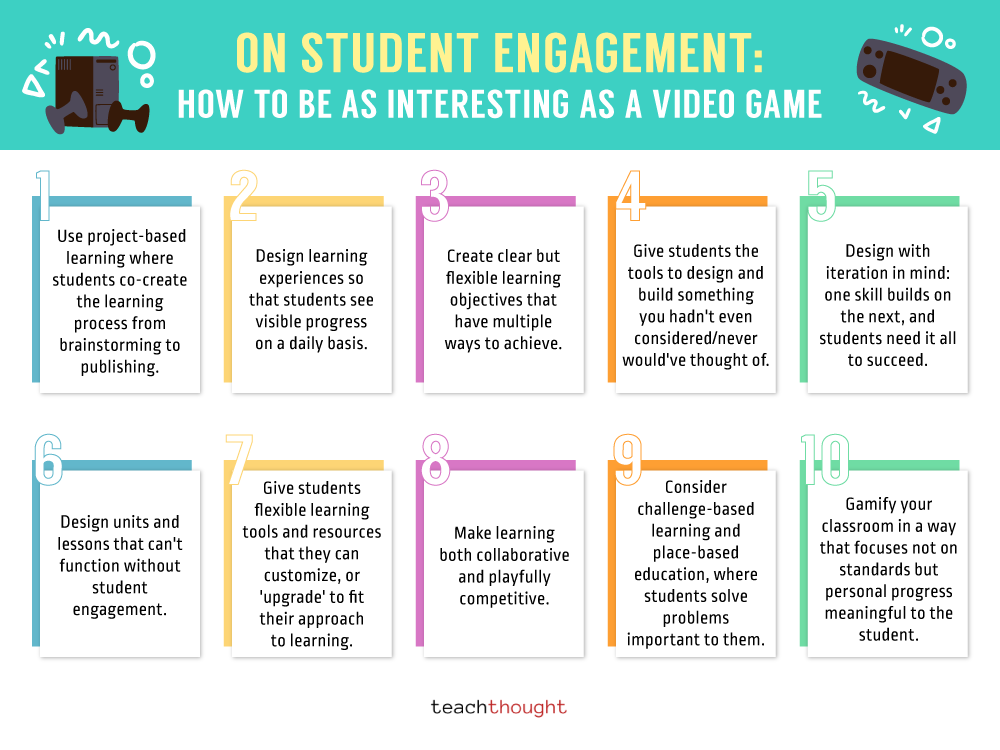
10 Student Engagement Strategies That Empower Learners
1. Design lessons that ‘can’t work’ without student engagement.
2. Design learning experiences so that students see visible progress on a daily basis.
3. Make objectives clear, and offer student engagement multiple ways to accomplish them.
4. Give students the tools to design and build something you hadn’t even considered/never would’ve thought of.
5. Design with iteration in mind: one skill builds on the next, and students need it all to succeed.
6. Use project-based learning where students design the entire process from brainstorming to publishing.
7. Give students malleable learning tools and resources that they can customize, or ‘upgrade’ to fit their approach to learning.
8. Make learning both collaborative and competitive.
9. Consider challenge-based learning and place-based education, where students solve problems important to them, in communities that are watching.
10. Gamify your classroom in a way that focuses not on standards, data, or ‘proficiency,’ but personal progress meaningful to the student.
These approaches, while vague, can help you get the jump on learning engagement in your classroom that parallels the stuff that captivates them so completely on all those digital screens.
Founder & Director of TeachThought